Learn about what you can do with used practice boards.
Howdy !
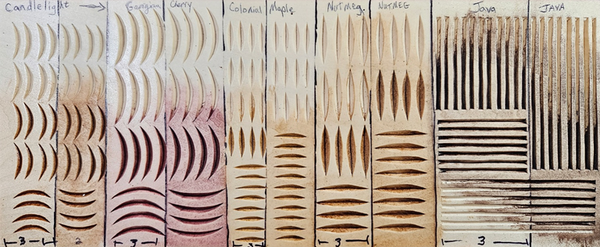
Now that you’ve had some time to practice chip carving, what can you do with your practice boards when you’re finished? Use them to practice your finishing techniques without the pressure of working on a final project! Your practice board is likely to have chips going with the grain and across the grain, which makes it great for seeing how
different finishing techniques work on both types of chips.
Above, I’ve used a practice board to test how a variety of gel stains appear over 2 and 3 coats of spray clear matte acrylic. As expected, you can see that the gel stain over 3 coats of acrylic is significantly lighter, and you can also compare the colors of the different stains when deciding how to finish your latest project. Having a reference for the various colors, as well as experience applying gel stains,
helps build confidence when the time comes to finish an actual carving.
Looking for a uniform stain, then test out some pre-stain conditioner and see the results. Or maybe you’re curious about adding some color. Whether it’s paint or color pencils, the practice board is a safe place to take them on a test drive. See how the colors look once they’re dry and test out different color combinations. Don’t let the practice stop with the carving… continue with practicing
your finishing skills!
If you’re looking for a deep dive on finishing, be sure to check out the Finishing Course! Be sure to read about Bob's finishing technique on Butternut in this week's newsletter.
What projects have you been working on lately? I'd love to see them! Please send them to troy@mychipcarving.com.
February's Monthly Project
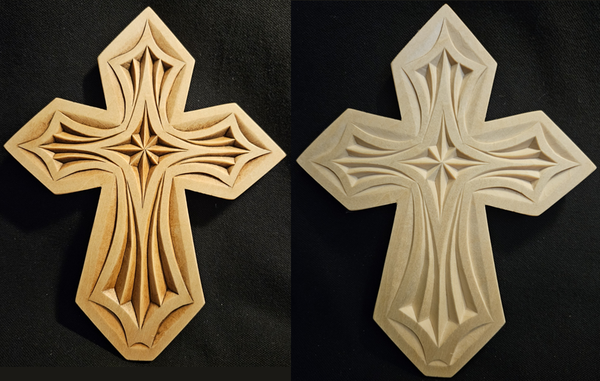
7" x 6" Wall Cross:
Inner Cross Pattern
The Old World Style cuts along the outside edge, highlight an inner cross pattern made up of Swiss-style chip carving cuts. On the left, I've added some gel stain over 3 coats of clear acrylic, while the right is unfinished basswood. Either way, I think it's a beautiful pattern that's fun to carve!
Order a Wall Cross with or without a Pattern applied.
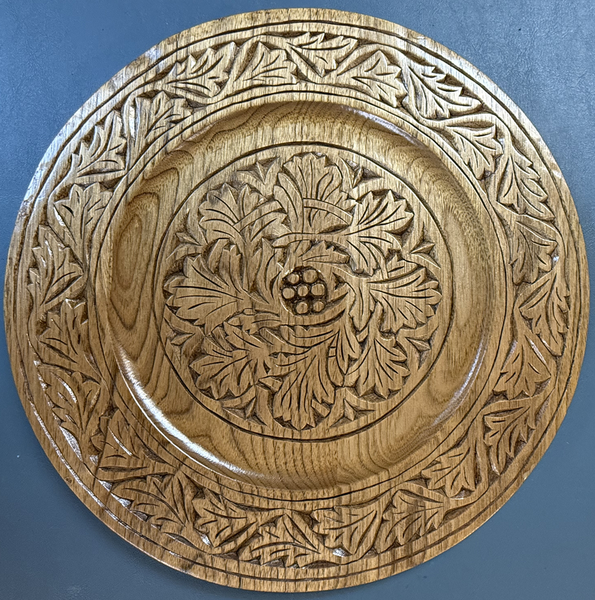
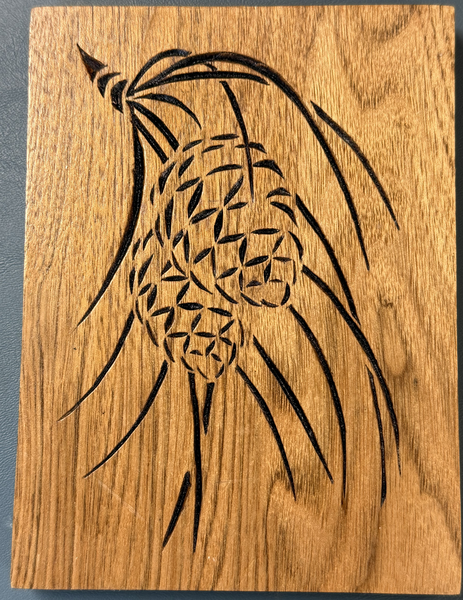
In your weekly post a couple of weeks ago I read some comments from you and others about chip carving in butternut. It seemed most of the folks steer clear of butternut chip carving when they really shouldn't. Attached are two pictures of items I've carved in butternut. I love carving butternut with it's warm brown colors and beautiful grain. That being said, it isn't best when trying to
achieve the shadows needed for chip carving to be effective. Following is a technique I learned years ago and I use it nearly every time I chip carve in butternut.
Carve the pattern normally without any finish applied. Once finished with the carving, apply three coats of clear spray lacquer over the entire surface making sure the carved recesses are sprayed well - and drying and sanding the surface lightly between coats with a 220 grit or finer sandpaper.
After this I
apply a darker (I use Aged Oak) gel stain just into the carved areas with a stiff bristle brush. After the gel stain is applied I dab the carved areas with the brush and frequently wipe the bristles and re-dab until the stain is mostly gone. I want to remove most of the stain so it doesn't fill the nicely carved area, but still leave enough in the recesses to create contrast. After you are done cleaning the recesses, wipe the surface with a dry paper towel to remove all traces of stain on the
uncarved surface. Once the gel has dried in the recesses (usually the next day), I spray one final coat of lacquer over the entire piece.
The tip here is to seal the grain in the recesses and to use gel stain which doesn't readily wick into the grain.
I find this process allows the butternut to show it's beauty in addition to the beauty of the carving design.
Bob
Thanks for sharing your technique for carving butternut. Your carvings are a great example of how it adds contrast while showing off the wood's color. It's similar to the technique I use on Basswood, except I apply gel stain to the entire carving, but with Butternut's color, it makes sense only to apply it to the carved areas.
Platinum membership gives you access to ALLof the Courses,Patterns, and Video archives!